AI Is Exposing What’s Missing
Enterprises are investing heavily in AI. Yet many are struggling to move from pilots to production.
The common assumption is that the limiting factor must be the model or the data platform. In reality, the constraint is something less visible: AI lacks access to the context that governs how the enterprise actually works.
For years, data platforms were designed to support reporting and analytics. They helped teams analyze trends and answer questions humans already knew to ask.
AI changes the nature of the problem. Modern AI systems don’t just retrieve information. They interpret, synthesize, recommend, and increasingly, act. They must reason across systems, apply business rules, and trigger workflows. They are expected to operate with speed and autonomy.
That kind of reasoning requires more than data access. It requires shared meaning.
In most enterprises, that meaning is deeply embedded in documents, tribal knowledge, workflows, and custom scripts. Definitions vary across systems. Business logic is hard-coded in pipelines. Policies sit in PDFs. Institutional knowledge lives in people’s heads.
Humans compensate for this fragmentation through experience and judgment. AI systems cannot.
When context is scattered or implicit, AI fills in the gaps. And confident approximation at enterprise scale is risky.
The Context Layer: What AI Actually Needs
What enterprises need now is not simply more data infrastructure. They need a data foundation that has a shared, explicit representation of how the business works.
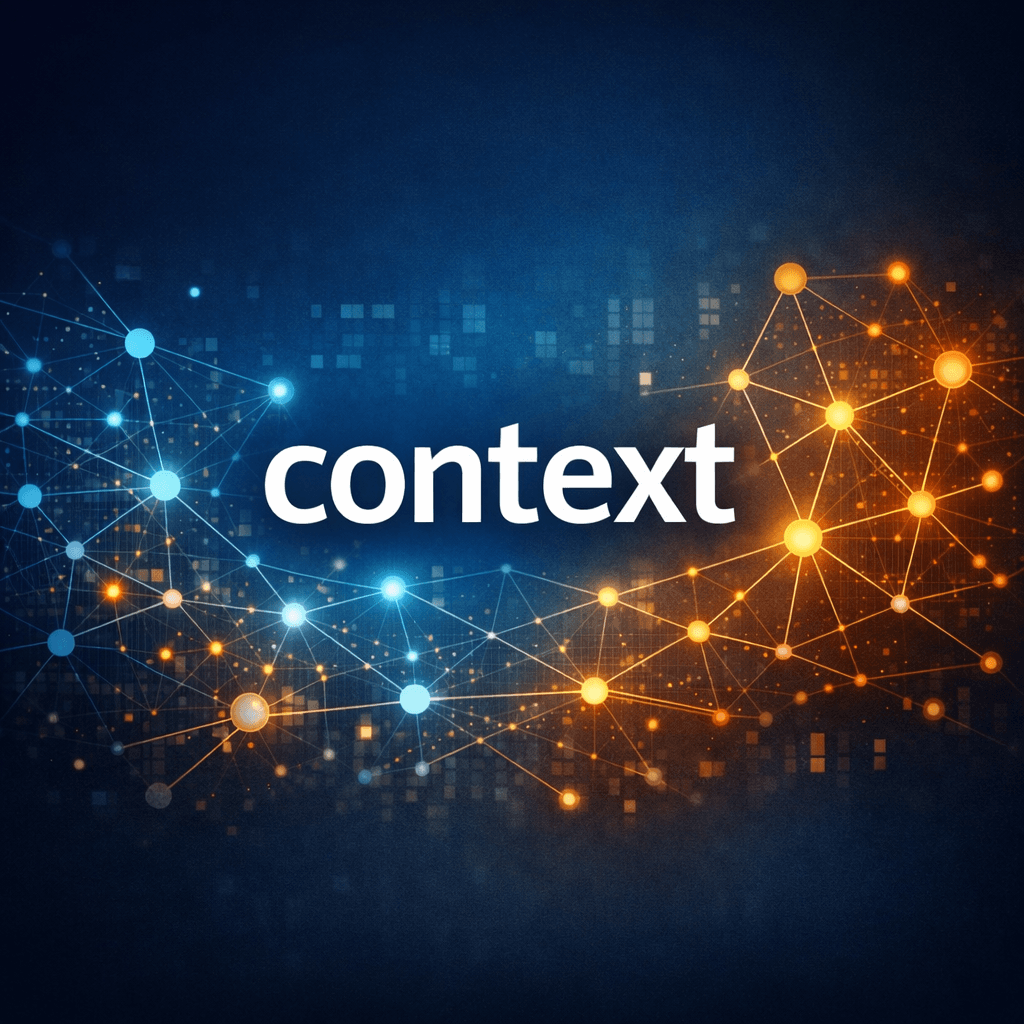
That representation is what we call the context layer.
The context layer captures:
- Core business concepts and how they relate
- Critical reference data and shared terminology
- Metadata describing structured and unstructured assets
- Business logic, policies, and guardrails expressed in machine-readable form
It connects what data means, where it lives, and how it should be used.
Without this layer, AI systems operate on patterns alone. With it, they can reason against definitions, relationships, and governed rules.
Context is not another dashboard or metadata catalog. It is not simply a semantic optimization layer for business intelligence. It is the connective tissue between your data and the systems – human and machine – that depend on it.
It is the missing link that determines whether AI scales safely or fragments into brittle point solutions.
Autonomy depends on more than access to data. It requires that foundational data be placed in context that is explicit, nuanced, and continuously maintained. Without that context, AI agents cannot reason safely. They default to pattern matching and probability rather than policy and intent.
The difference between an AI assistant and a truly autonomous system is not simply the sophistication of the model. It is the strength and clarity of the foundation beneath it.
Introducing TQ Data Foundation
For more than a decade, TopQuadrant has partnered with leading enterprises to connect and standardize the foundational data that runs their businesses. Semantic maps of business meaning, such as Ontologies, comprised a core part of building data foundations to convey truths. Workflows, processes, and automation flourished. The challenge of shared meaning began with humans – but AI and its agents, with their thirst for autonomy, have made it impossible to relegate context to a semantic corner.
TQ Data Foundation builds on the experience of delivering shared business meaning mapped across disparate silos. TQ is a unified SaaS platform that captures enterprise knowledge and builds the context layer AI needs to operate accurately and at scale.
TQ takes the knowledge that already exists across your organization – in documents, systems, spreadsheets, workflows, and subject matter experts – and transforms it into structured, connected representations:
- Models, which represent core business concepts and how they relate.
- References, which align critical terms and entities across teams and systems.
- Metadata, which describes structured and unstructured assets across the organization.
- Business logic, which expresses policies, rules and guardrails in enforceable, machine-readable form.
TQ Data Foundation unifies this data in a knowledge graph, creating a living, interconnected representation of your enterprise. This makes explicit what is often implicit: what data means, how concepts connect, where information resides, and which rules govern its use. It externalizes this shared understanding so it can be reused consistently across AI agents, analytics platforms, and operational systems.
When definitions evolve, the graph evolves with them. When policies change, downstream systems remain aligned. When the organization grows or restructures, shared meaning remains intact.
Context becomes durable rather than brittle.
Why AI Fails Without Context: A Tale of Two AI Misses
The Bank
Not long ago, a large bank rolled out an AI assistant to help identify customers eligible for a new premium credit card.
The model performed well in testing. The interface was polished. The early demos were impressive.
Within days of launch, the marketing team had sent eligibility offers to dozens of minors – children listed as beneficiaries on their parents’ accounts.
Technically, the AI had done exactly what it was asked to do. It searched for “customers” who met certain criteria and returned a list. The problem was that it didn’t understand what customer meant in context. It couldn’t distinguish between an account holder and a beneficiary. It didn’t know how internal eligibility rules were defined, or which policies constrained the action.
The data existed. The model worked. But the decision was wrong.
This wasn’t a failure of artificial intelligence. It was a failure of shared business context.
With a governed context layer in place, “customer” would be explicitly defined. Eligibility criteria would be expressed as enforceable business logic. Policy constraints would be embedded directly into the reasoning layer.
The AI would not merely retrieve records that match a query. It would understand which actions are permitted and why.
The model would not need to change. The data would not need to change.
But the context layer would.
And the outcome would be fundamentally different – accurate, explainable, and defensible.
The Pharmaceutical
A global pharmaceutical company deployed AI to accelerate safety reporting—and it delivered impressive results.
The system could scan thousands of adverse event reports, identify relevant cases, and draft sections of regulatory submissions in hours instead of weeks. The early demos were compelling. The efficiency gains were measurable.
Then a submission was flagged during regulatory review. The AI had included an adverse event case that should have been excluded—the patient was also taking a contraindicated medication, a detail buried in clinical notes. Technically, the event met the search criteria. But it violated reporting guidelines that required clinical context, not just pattern matching.
The AI could process information faster than any human team. But it couldn’t interpret what the information meant in the context of regulatory requirements.
The limitation wasn’t the model or the data access. It was context.
The system knew “patient experienced adverse event X” but didn’t understand how patient history, concomitant medications, and reporting guidelines intersected to determine what should be included. Safety data lived in one system, clinical context in another, regulatory logic in policy documents. The AI could retrieve facts but couldn’t reason about their meaning.
The data existed. The model worked. But trustworthy regulatory decision-making was impossible.
Now imagine that same scenario with a context layer in place—a unified representation connecting adverse events, patient profiles, drug interactions, and regulatory requirements. Medical terminology is standardized. Reporting logic is explicit and machine-readable. Policy constraints are embedded as enforceable rules.
When the AI drafts a submission, it doesn’t just match patterns. It reasons against explicit definitions of reportability, evaluates clinical context, and applies regulatory logic. A human reviews and approves. The submission is accurate, compliant, and defensible.
But the context layer would. Starting to sound familiar? Once again, the outcome would be fundamentally different – accurate, explainable, and defensible.
Why Context Matters for AI Now
Enterprises are moving from AI experimentation to AI in production. Expectations are rising – for accuracy, compliance, and measurable ROI.
The organizations that succeed will not simply deploy more agents. They will invest in making enterprise context explicit, connected, and continuously governed.
Without that investment, AI initiatives fragment into isolated pilots. Outputs become inconsistent. Trust erodes. Regulatory exposure increases.
With a robust context layer, AI systems reason correctly the first time. Teams move faster without sacrificing governance. And AI can scale across the enterprise rather than remaining confined to isolated use cases.
Join Us: Scale Trustworthy AI with TQ Data Foundation
TQ Data Foundation helps enterprises capture knowledge and transform it into a living context layer, enabling AI to reason accurately, scale reliably, and earn trust over time.
Join our webinar to see how TQ Data Foundation captures, activates, and evolves the context your AI systems need to operate reliably. Or connect with our team to explore how your organization can move from AI experimentation to AI you can trust in production.
AI will continue to move quickly. Your foundation should be built to keep up.