Most AI projects don’t fail because the model is wrong. They fail because the model doesn’t know your business.
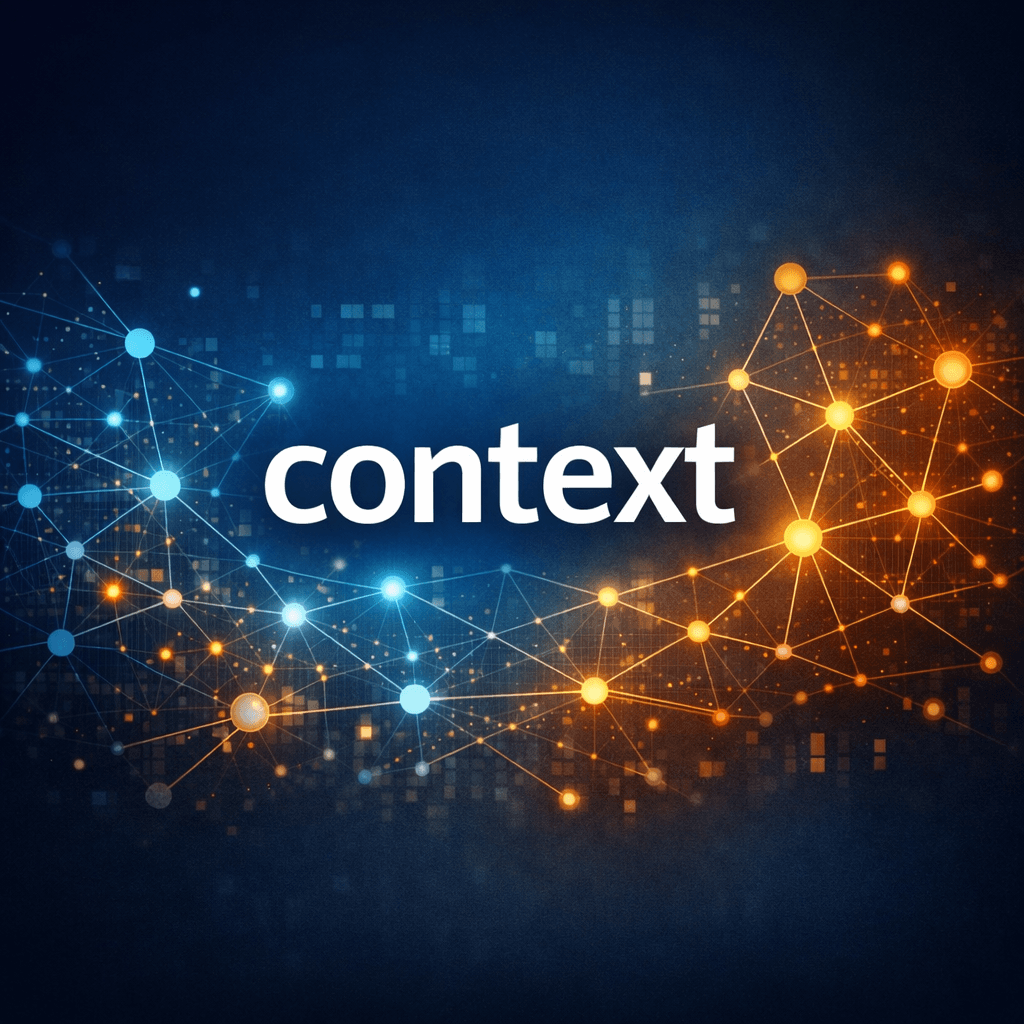
That gap has a name. It’s called a context problem. And while that framing has started to click with business leaders in a way that older terminology like “knowledge graph” or “semantic layer” never quite did, the more useful realization is this: most organizations are already building the solution. They just haven’t connected the pieces.
The problem that keeps showing up
Ask an AI system a business-critical question without the right context, and you’ll get one of three outcomes: a wrong answer delivered with confidence, a technically correct answer with no explanation of how it got there, or an answer that burned through an enormous number of tokens to reconstruct knowledge your organization already has somewhere.
In a recent live demonstration, we asked an AI system to identify which customers were eligible for a new credit card product. Without access to the organization’s context, it returned five names. The correct answer was seven. More telling than the wrong count was what happened when we asked how it made that determination: it admitted it had applied criteria it invented on the spot, using the data schema and its own judgment. There was no traceability back to actual policy.
That’s not a model failure. That’s a context failure.
Four things that make context work
When we talk to customers about what “context” actually means in practice, it comes down to four things:
Knowledge. The facts that are true about your business, your entities, your products, your metrics. What are the terms that actually mean something specific here? A “customer segment” in your marketing system and a “risk band” in your compliance system may refer to the same underlying concept. Does anything in your current stack know that?
Relationships. How do those entities connect? A product is governed by an offer. An offer is governed by a policy. A policy has requirements. These relationships are often implicit in people’s heads or buried in process documentation rather than formalized anywhere a machine can use.
Descriptions. Metadata that makes data understandable: what this table means, who owns it, where it came from. Not just column headers, but the meaning behind them and how they map to the business terms people actually use.
Rules. The policies, constraints, and permissions that govern how decisions get made. Not buried in PDFs that AI has to guess at, but codified in a form that’s traceable and auditable.
When these four things are linked and governed, the difference in AI output is significant. In the same credit card example, with that context in place, the system returned the correct seven customers, cited the specific eligibility policy that drove the answer, and linked back to the source documents in SharePoint and the underlying data in Databricks. Every step was explainable. Every citation was verifiable.
The context you already have
Here’s what we find consistently when we start working with a new customer: the context exists. It’s just not connected.
It lives in a Unity Catalog in Databricks. In a term store inside SharePoint. In the schema of a CRM that a subject matter expert knows better than anyone but has never formally documented. In PDFs that describe policies but aren’t linked to the data those policies apply to.
The challenge isn’t that organizations haven’t invested in this. The challenge is that what’s in Databricks isn’t linked to what’s in the CRM. What a compliance team calls “risk band” isn’t formally mapped to what a marketing team calls “customer segment.” When AI hits those gaps, it either hallucinates a bridge or tells you it can’t cross.
The work of building a context layer isn’t starting from scratch. It’s linking what you have, making it authoritative, and making it reusable.
Linked means the column header in your data warehouse maps to a governed term, not just another column header somewhere else. Strings become things.
Authoritative means that when there’s conflicting information across systems, someone has made a call, and that decision is captured. Humans make things authoritative. The platform makes that decision accessible and traceable.
Reusable means the context you build for one use case can serve the next one. You’re not rebuilding the foundation every time.
Where this matters most
The use cases where context delivers the highest return share a few characteristics: they cross departmental lines, they pull from multiple systems, or the cost of getting it wrong is high.
In financial services, this looks like customer eligibility decisions that need to be explainable to auditors and compliant with policy at the same time. In life sciences, it’s regulatory submissions where data accuracy directly affects approval timelines, and where any inaccuracy on post-launch safety data carries real organizational risk. In infrastructure, it’s predictive maintenance across complex asset networks where downtime is expensive and the data needed to prevent it is scattered across dozens of systems.
What these use cases have in common is that they can’t be solved by connecting an LLM directly to a data source. They require the links between systems to already exist, to be governed, and to be trusted.
A practical starting point
The most successful starting points we’ve seen follow a similar pattern: begin with a specific competency question, something your organization genuinely needs to answer reliably, and work backwards from there.
What data is required to answer it? Where does that data live? What terms or concepts need to be defined and agreed upon across the teams involved? What policies apply, and are they captured anywhere a machine can use?
That scoped exercise tends to surface both what you have and where the gaps are. It also produces something immediately useful, rather than a large infrastructure project with a distant payoff.
For organizations thinking more broadly about shared enterprise context, the question shifts to: what is the critical information that the most important processes in your organization run on? Start there. Govern it. Make it available.
Governance is usually what’s blocking progress
The technical work of connecting systems is solvable. What tends to block progress is the governance layer: who owns this term, who can change it, what’s the process for an edit to become authoritative?
A controlled vocabulary with one owner who never changes is not usable at enterprise scale. A taxonomy that anyone can edit without review is not trustworthy enough for AI to rely on. The answer is workflow: suggested edits that go through approval before they become committed, with clear ownership at the asset level. That’s not complicated. It is discipline.
Open standards matter here too. Context built on proprietary formats is context you don’t fully own. Formats like SHACL, OWL, and the broader W3C stack ensure that your semantic assets remain portable and interoperable across the systems that need to consume them.
The ROI that often gets overlooked
Organizations tracking the return on context layer investments tend to start with accuracy and speed. Fewer wrong answers. Faster go-to-market on campaigns and products. Decisions that were previously too risky to make with confidence becoming tractable.
One ROI that’s getting more attention: token efficiency. An AI system that has well-governed context available doesn’t need to reconstruct policy from raw data every time a question is asked. That reduction in token consumption compounds quickly at scale. It’s not the primary reason to build a context layer, but it’s a real and increasingly measurable benefit.
You’re closer than you think
The conversation has shifted. Organizations that were running pilots 12 months ago are moving into production. The ones making that transition most successfully tend to share a common thread: they invested in the context layer before the agent, not after.
The assets you need are likely already in your organization. The gap is usually not technical. It’s that those assets are siloed, unlinked, and not governed in a way that makes them trustworthy at scale.
If you’re ready to take stock of what you have and understand where the gaps are, our Data and Context Maturity Assessment is a good starting point. It will help you see where you are on the maturity scale and what the most valuable next step looks like for your organization.
-> Watch the on-demand webinar.
TopQuadrant helps large enterprises in financial services, life sciences, and technology build the context layer that makes AI accurate, governed, and explainable.